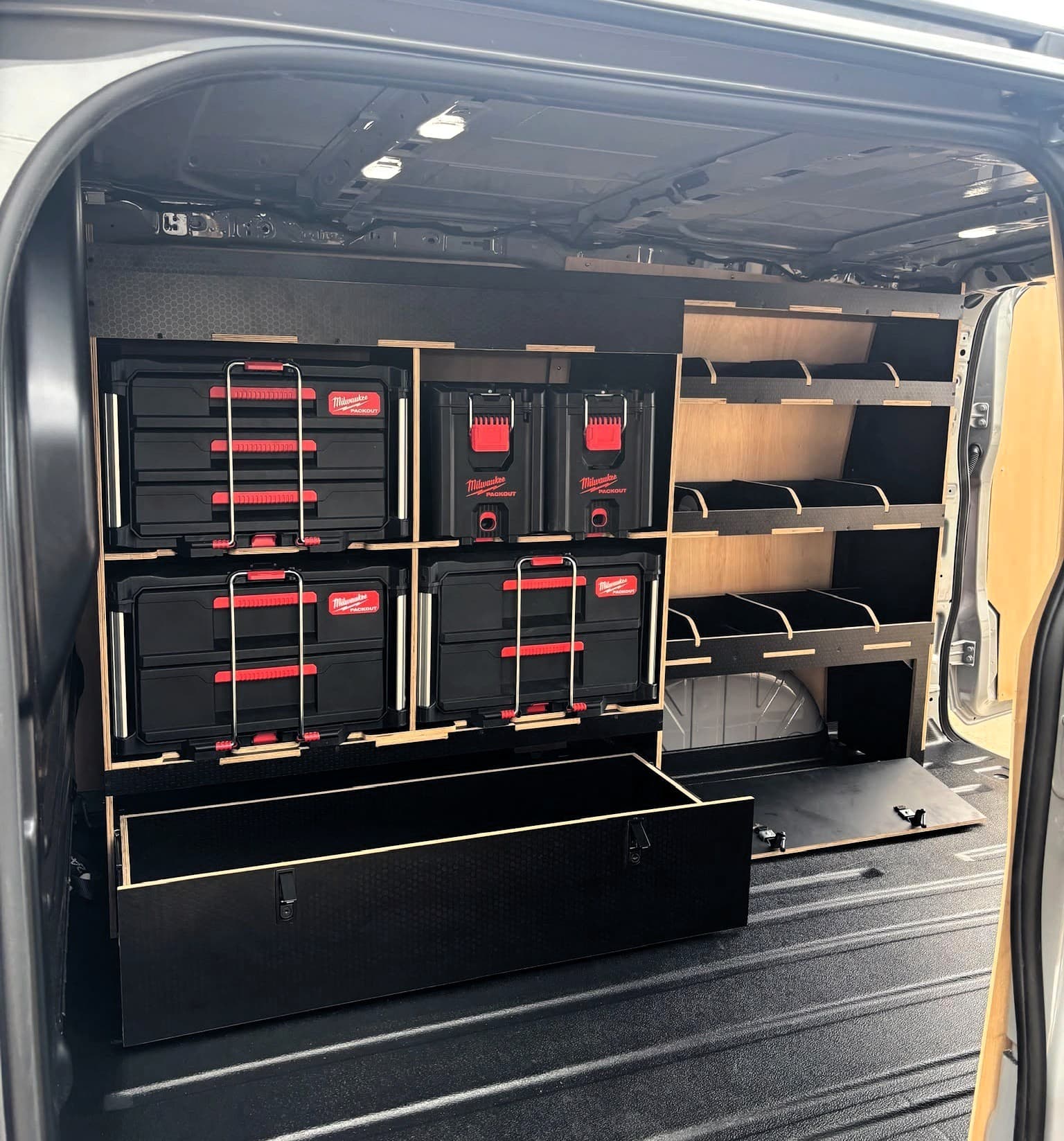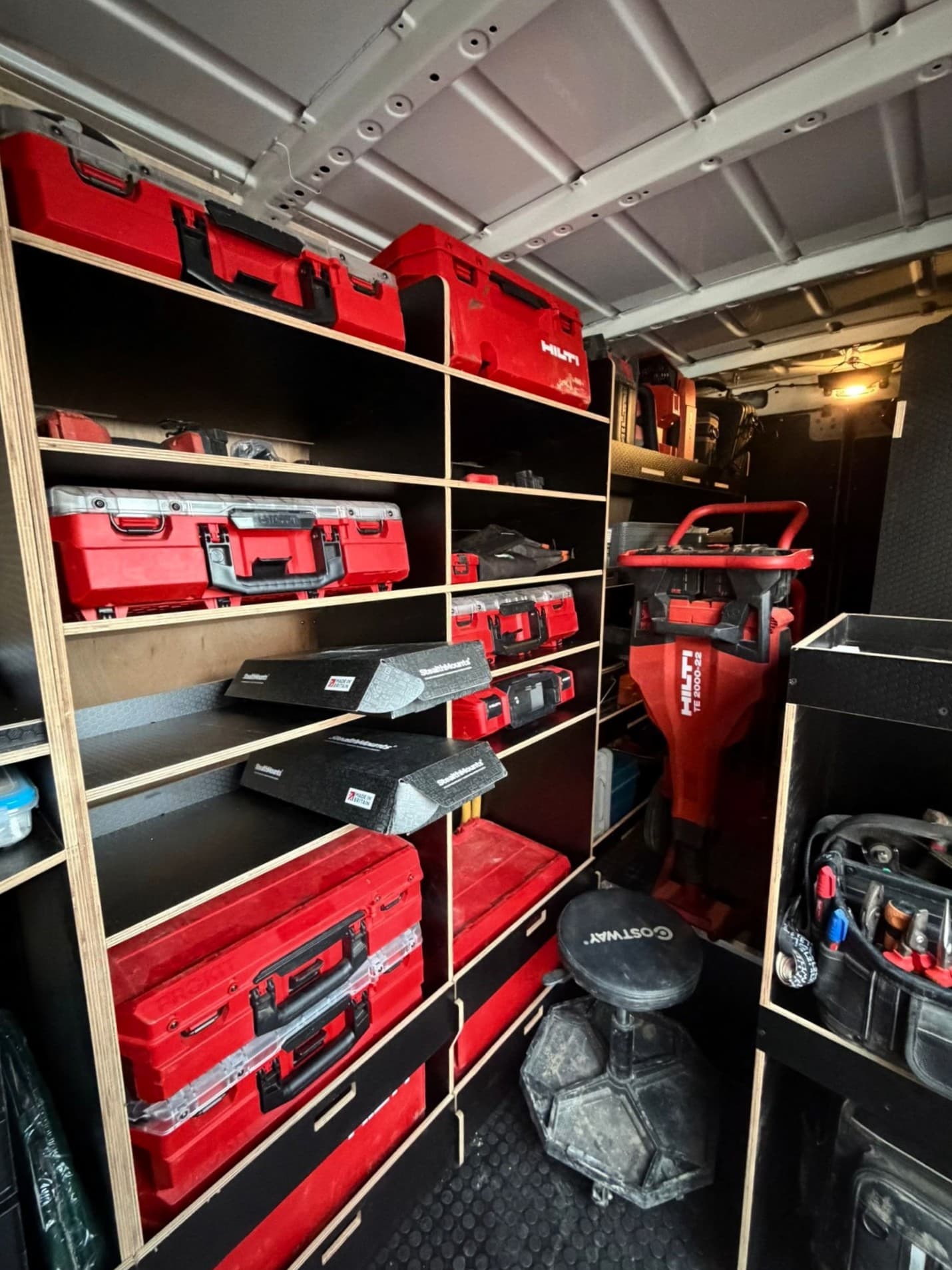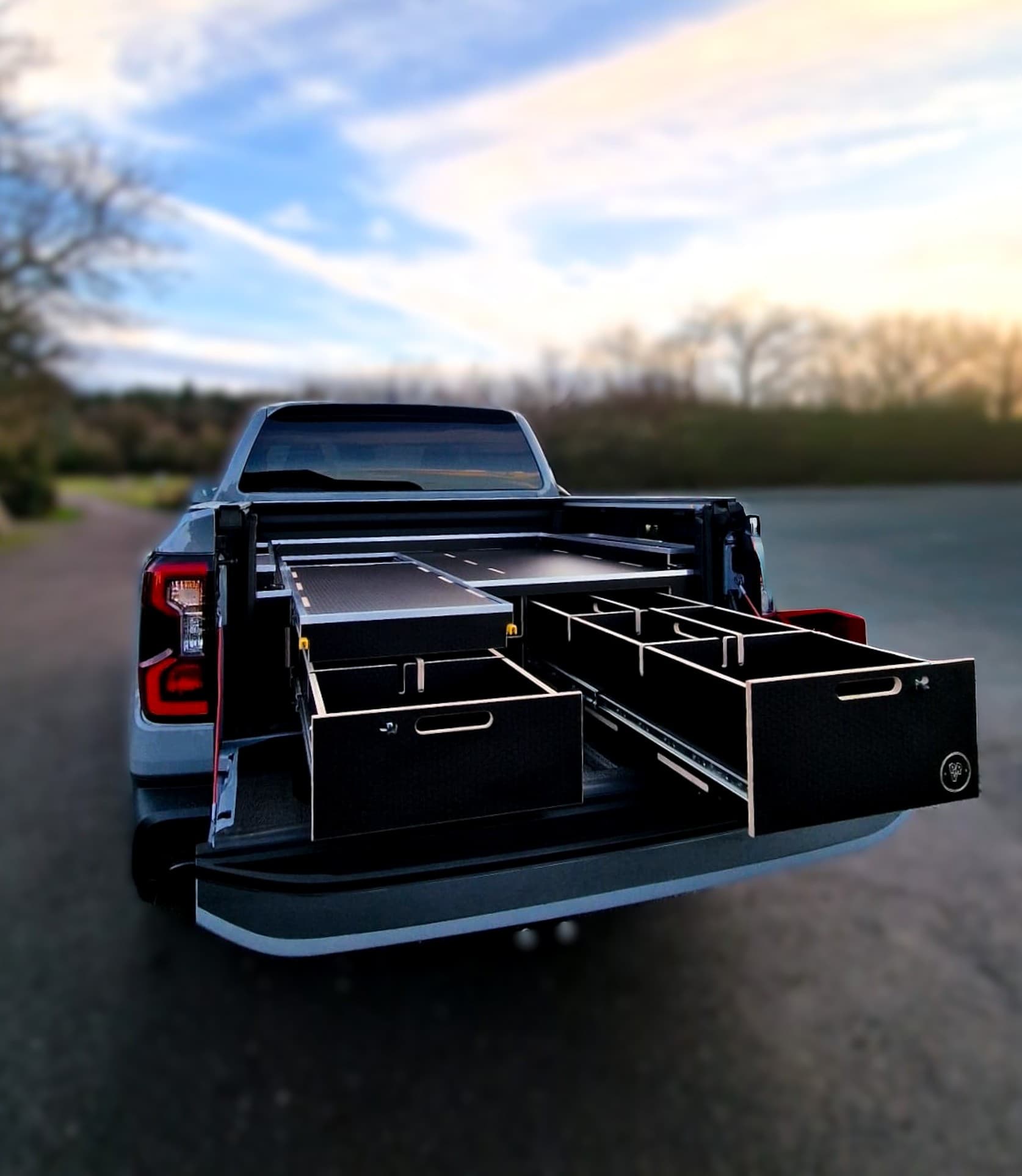
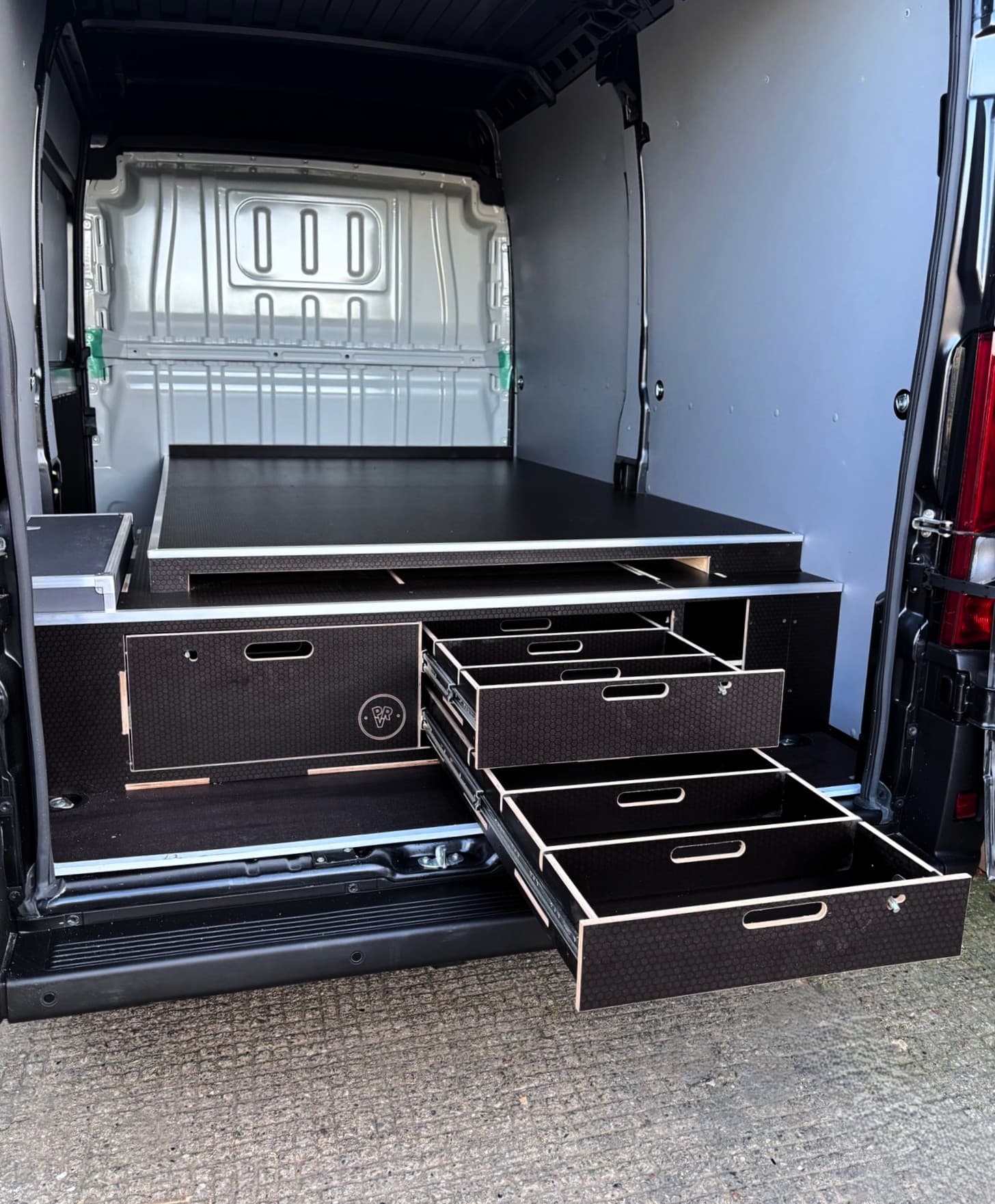
Most fit-outs include a false floor these days. Building the space underneath specifically around sheet materials is a different proposition — and it's the request we're seeing more of. Here's what it involves and who it suits.
A false floor is close to standard now. Flat deck over the ribs, storage underneath for rails, clamps and long lengths, and you load on top as normal. What's much less common — and what we're being asked about more often — is designing that underfloor space specifically around sheet materials.
If you're carrying ply, MDF, plasterboard, laminate or underlay most weeks, it's worth understanding what's actually involved. It's a different proposition to a standard false floor, and it isn't the right call for every van.
What it actually is
The principle is straightforward. Instead of a general-purpose void under the deck, you get a full-width compartment sized around a standard 2440 x 1220 sheet, running from the rear doors forward.
Sheets go in flat and stay supported across their whole face. Depending on the build, they either slide into a fixed compartment from the door end, or sit on a heavy-duty runner so the sheet comes out to you rather than you climbing in after it. Above it, the deck is unaffected — cases, tools and materials load on top exactly as they would on any false floor.
The distinction that matters is that the storage is designed around the sheet size from the outset. A void that happens to be roughly sheet-shaped isn't the same thing, and you'll find that out the first time you try to get a full board back out of it with the van loaded.
What it's actually solving
Anyone who carries sheets loose knows the list already. Corners knocked and edges chipped against racking. Faces scratched by whatever slid into them on the way to site. Boards moving forward under braking because there's nothing to stop them. Everything else in the van buried underneath, so a sheet has to come out before anything else can.
Then there's the handling. Lifting a full sheet in and out over the top of the racking, at arm's length, on your own, is how backs go — and it's the part that gets worse rather than better over a career.
The cost of all that lands quietly. A scratched face on a pre-finished board isn't a repair, it's a replacement, and it usually shows up on the day you need it.
Which trades get the most out of it
Joiners and carpenters are the obvious ones, but they're not the biggest beneficiaries. The trades that gain most are the ones carrying pre-finished or easily damaged boards: kitchen and bedroom fitters with faced panels and end panels, floor layers running ply subfloor, underlay and boards, shopfitters, and anyone working with laminates, acrylics or signage material where the surface is the product.
Dryliners carrying plasterboard get a different benefit — less about surface damage, more about weight distribution and not having to unload the whole van to reach a board.
If sheets are an occasional thing for you, a decent floor and proper strapping will do. This earns its place when sheets are on board most days.
Why it's still relatively uncommon
Three reasons, and they're all legitimate.
It's bespoke rather than off-the-shelf. Floor profile, wheel arch positions, rear aperture height and load length all vary by vehicle, so this is designed and built around one van rather than picked off a shelf. That's a longer lead time and a higher cost than standard racking.
It costs you height and payload. A deck with a sheet compartment under it sits higher than a plain false floor, which eats into standing height and the space available to the racking above. The structure itself has weight, and sheets are heavy — worth knowing where you sit on your plated weight before adding both.
And it needs the length. A full 2440mm sheet wants a load bay comfortably over 2.5 metres, which rules out short wheelbase vans and makes some medium wheelbase vans marginal. Long wheelbase is the natural home for it, which is why our false floor with integrated sheet and drawer storage is built for large vans.
Talk it through against your own van
If you're carrying sheets most days, this is one of the few fit-out decisions that changes how the work feels rather than just how the van looks. Take a look at our van racking and storage systems to see how false floors and underfloor storage go together, or book a free design consultation and we'll work out whether sheet storage makes sense in your vehicle before anything gets built.
Tags
- van sheet storage
- bespoke van fit out
- false floor
- sheet materials
- van racking