A full cordless line-up, a mitre saw, rails, clamps and hundreds of separate fixings and ironmongery items — carpentry loads a van with more variety than almost any trade. Here's the setup that gives you the time back.
Carpentry loads a van with more variety than almost any trade. A full cordless line-up and the cases it lives in, a mitre saw and a stand, a track saw and rails, an extractor, clamps by the dozen, and a stock of screws, fixings and ironmongery that runs into hundreds of separate items. Most of it is needed on some jobs and none of it on others, which is exactly how carpenters end up carrying everything and finding nothing. Here's where the time actually goes, and how the van gets laid out to give it back.
The hour isn't lost in one go
Nobody loses an hour standing still. It goes five minutes at a time: shifting the mitre saw to reach the clamps stacked behind it, digging for a 5.0 x 80 you know you've got somewhere, unloading half the van at the door because everything came out in a different order to the way it went in. Then the reload at the end of the day, and every so often a trip to the merchant for something you already own but couldn't put your hands on.
None of that feels like wasted time in the moment. Across a week it's most of a day, and across a year it's more than a working week. The fix isn't being tidier — plenty of tidy vans are still slow. It's that every item has one known home and nothing is stored behind anything else.
Build the van around the case system, not just the tools
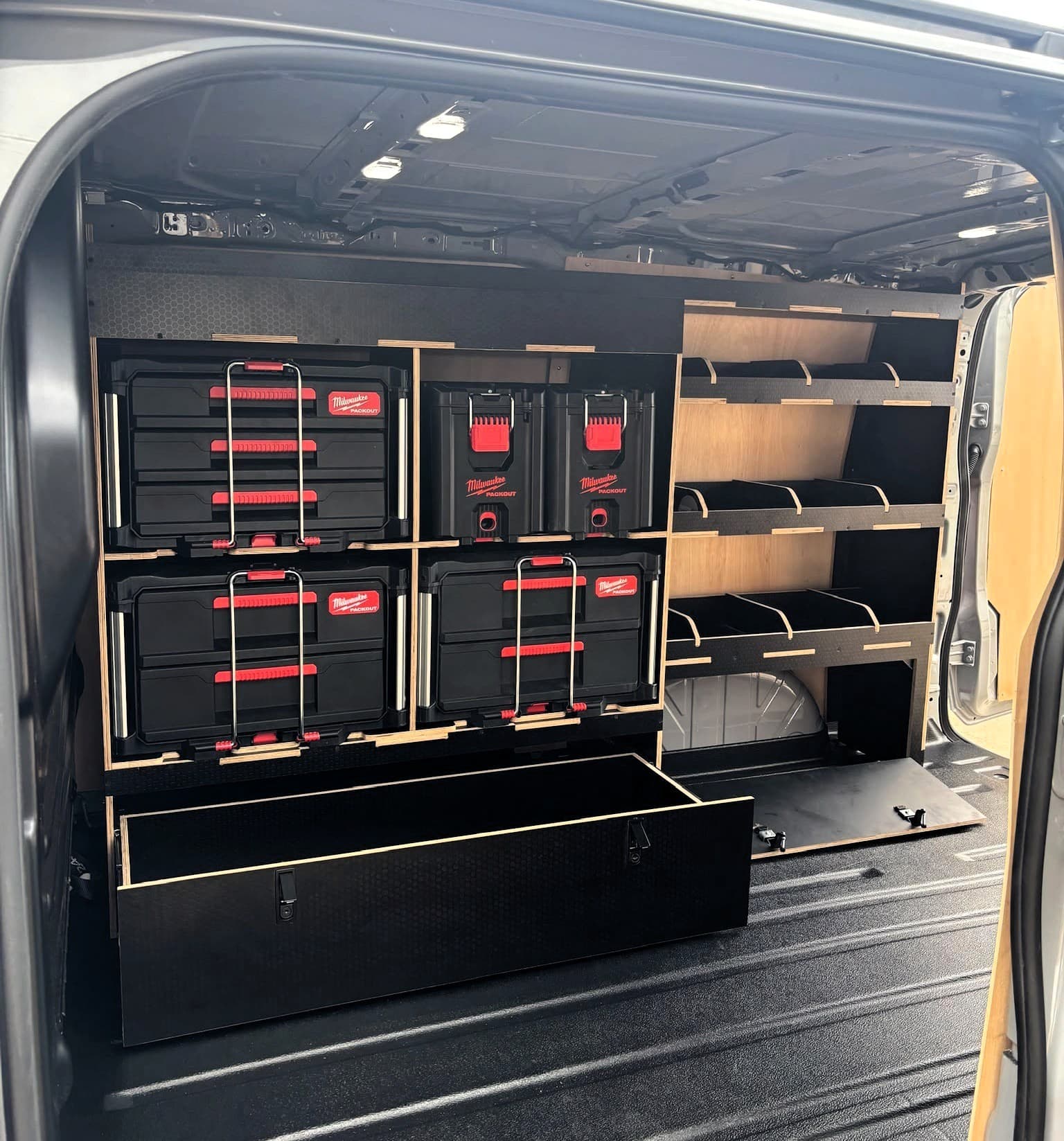
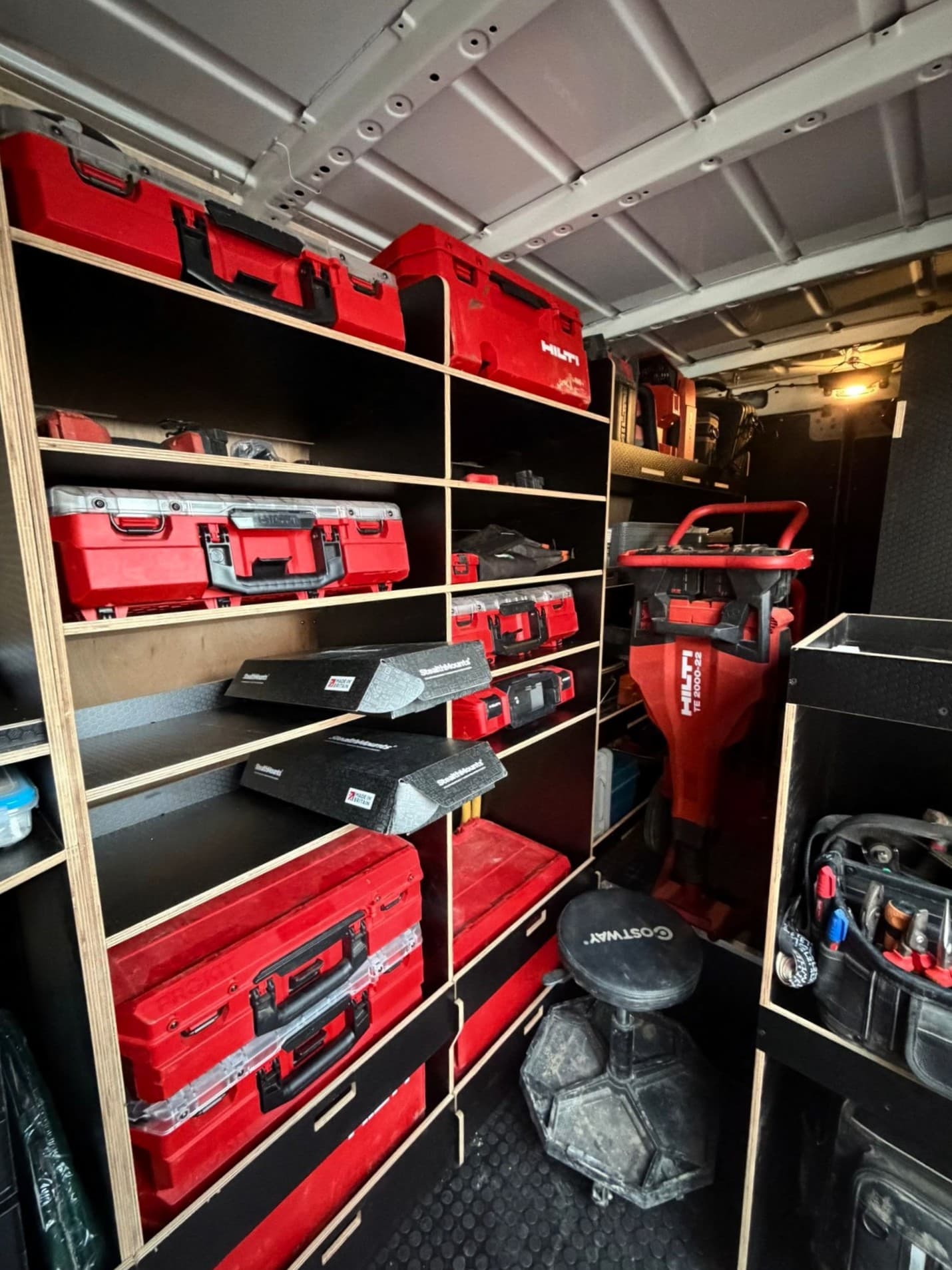
Most carpenters run a stacking case system, and the common mistake is racking that ignores it — shelves sized for boxes you don't own, so the cases end up loose on the floor, stacked four high and going over on the first roundabout.
Size the openings to the cases you actually use, one stack per opening, so any case slides out without lifting the two above it. Give batteries and chargers their own shelf near the doors, and if you can, a charging point wired in so you're topping up between jobs rather than turning up with four flat packs and one good one.
Fixings and ironmongery have to be visible, not just stored
No trade carries the variety a carpenter does. Screws in a dozen lengths and gauges, pocket screws, nails and gas for the first and second fix guns, hinges by type and size, catches, latches, handles, runners, brackets, adhesive, foam, abrasives, router cutters and spare blades.
Tip that lot into a few buckets and two things happen. You spend your mornings digging, and you buy another box of something you've already got three of because you can't see what's in there.
Shallow drawers and Euro containers fix it — one item type per compartment, labelled, in plain sight the moment you open the door. Grab the right fixing in five seconds rather than fifty. Just as usefully, you can see what's running low on a Friday afternoon instead of finding out on site on a Tuesday morning with the customer waiting.
Heavy gear: load order matters more than capacity
Mitre saw, stand, extractor, table saw, clamps and a run of architrave — carpentry runs heavy, and it's easy to load a van to the point where payload is a genuine question rather than a technicality. But two things matter more day to day than how much you can physically fit in.
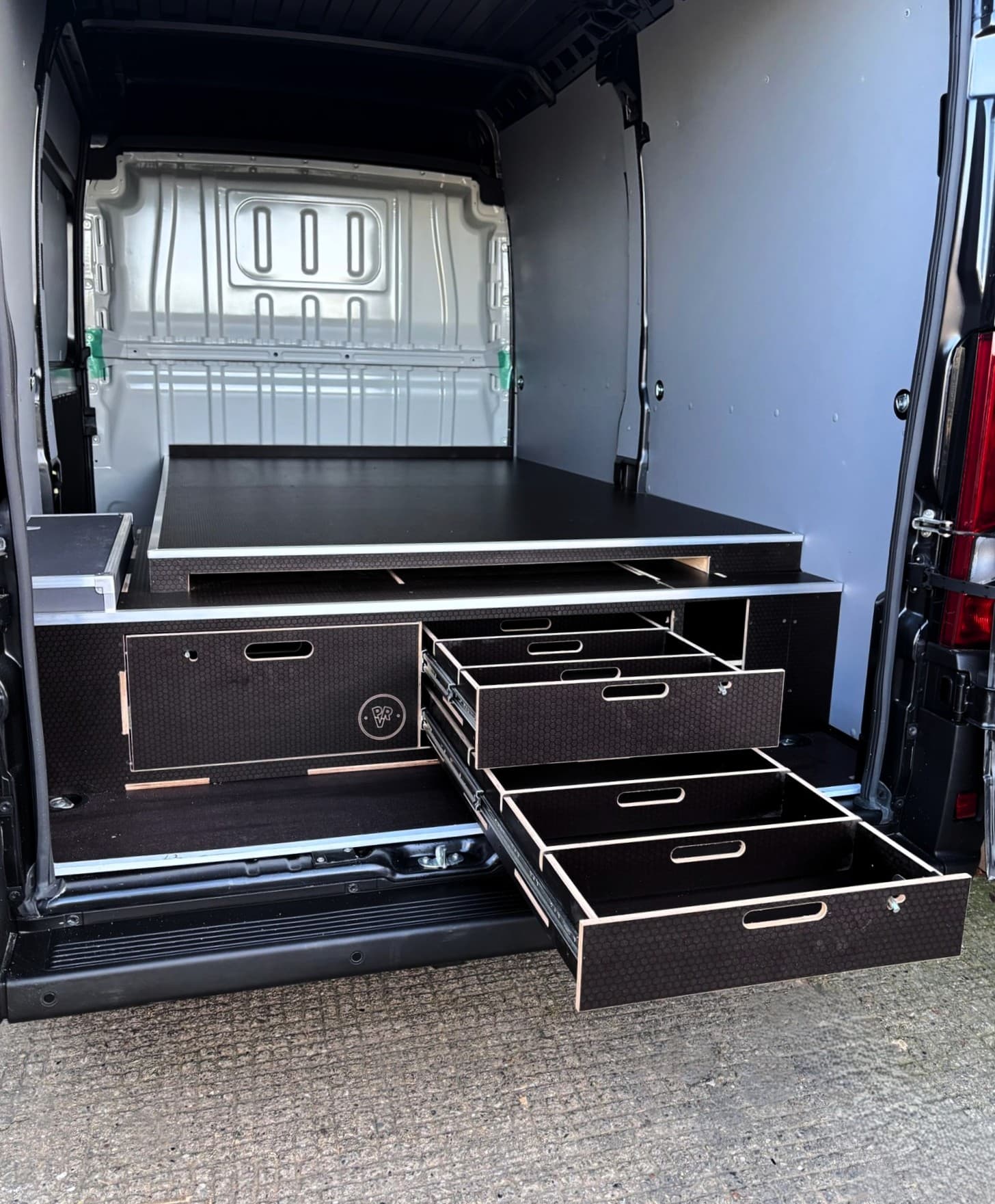
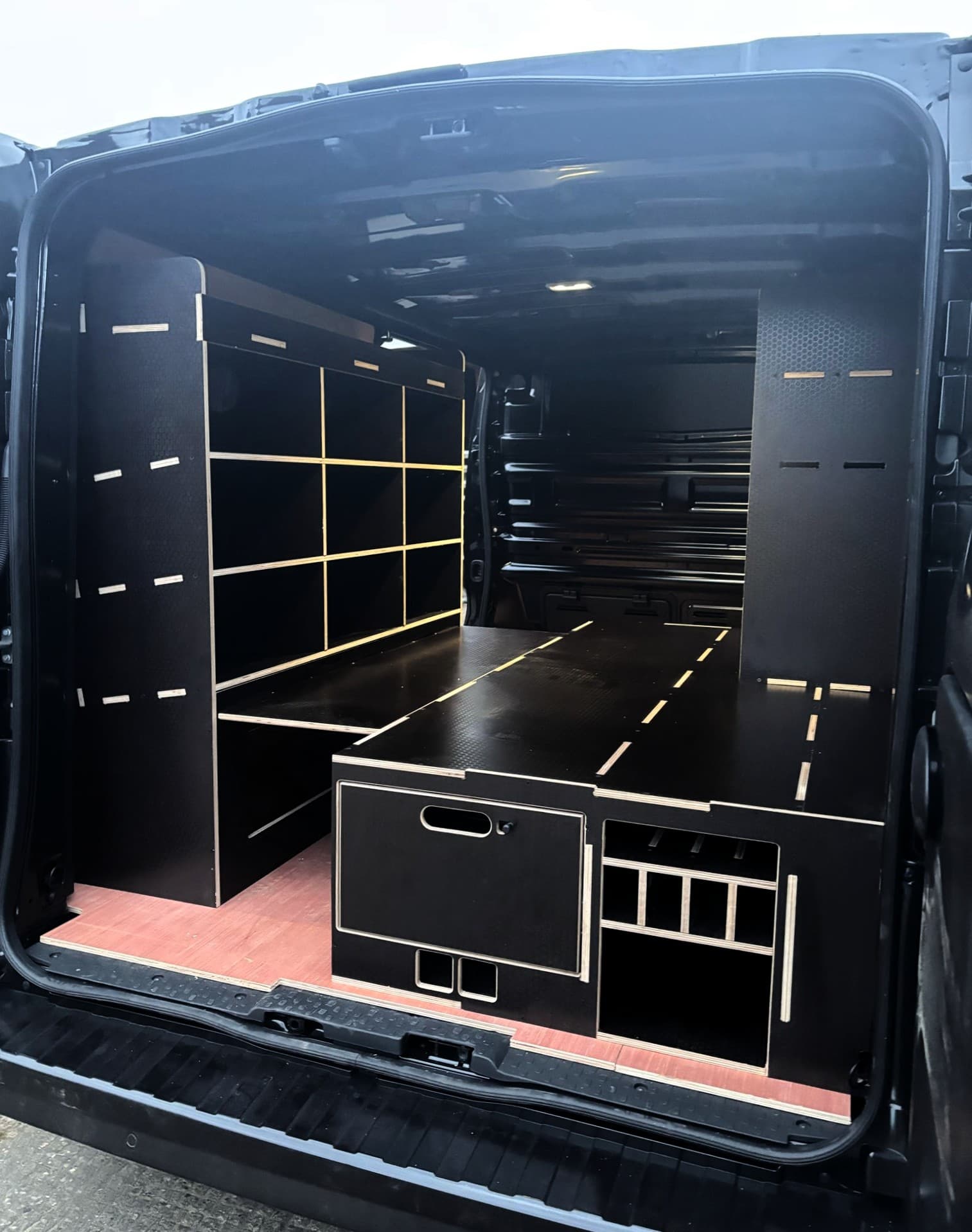
The first is where the weight sits. Keep it low and central, over the rear axle rather than hanging out behind it, and the van steers and stops like it should. A false floor earns its place here — a flat, solid deck to load the saw and the vac onto, with full-length storage underneath for rails, clamps and long trim.
The second is load order. Store in reverse order of use, so the first thing out of the van sits nearest the doors and nothing needs unloading to reach anything else. Give rails their own channel while you're at it — a bowed guide rail costs you accuracy on every cut it makes, and it only takes one trip under a mitre saw to bend one.
Set the van up around the way you work
Carpentry doesn't need a bigger van, it needs the van laid out around how the work actually runs. That's how we build: we start with the tools you carry, the case system you're on and the jobs you do most, then design the racking around it in natural ply or hex phenolic, fitted to outlast the vehicle. Take a look at our van racking systems to find a setup built for your trade, or book a free design consultation and we'll plan one around the way you work.
Tags
- carpenters
- van racking
- carpenter van setup
- tool storage
- fixings storage